Wednesday, December 12, 2012

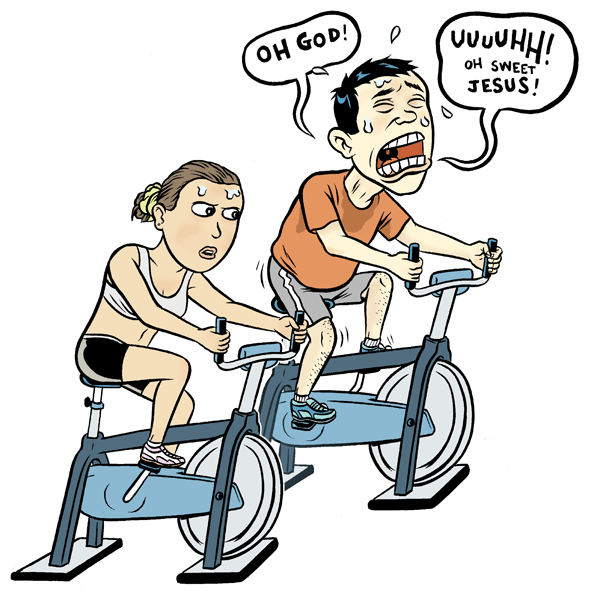
winter training. Spinning classes? really...


    As winter roars on, day light become more scarce, holidays keep coming and time to train becomes, well, non existent. It is vital to maintain a structured training program that keeps you motivated, improves your weaknesses and gets you ready to achieve next seasons’ goals.
Spinning classes are a great way to beat the winter cold. They’re offered at many gyms and if not at yours look to another club near by. Most clubs have a drop in rate that will allow you to take a class as a non-member. One problem that many triathletes and cyclists have with these classes is that they are unrealistic, an aerobics class on a bike.
The classes at Rallysport where I teach in winter are anything but. True cycling workouts and rides. Accurate power meters on every bike make these classes the best I have seen. 

  There are ways that you can turn a less than ideal spinning class into a great endurance and technical workout for you and your needs.
First off this is your workout not the instructors. If you’re doing the 10 minute “climb” in the saddle then stay in the saddle no one is going yell at you.  Further more, you control the tension, on the fly wheel, right? You control your intensity.  Then keep it at your intensity not Joe spinner’s next to you who doesn't even commute to work. 
Many times these classes are only one hour long. To short for you? Come early or stay late. Try to push past that key 70’ mark. I will be doing a webinar at Training peaks HQ on how to find your weak areas and talk about some tools and methods for maximizing your time in the winter months. This we will talk more about this there. Don’t miss it!  January 8th! 

  Spinning classes offer one of the greatest opportunity to work on technique. For starters you don’t have to balance the bike, steer,  be wary of traffic etc. Take this “stabilized” time to really focus on your pedal stroke. In the beginning of class take a few minutes to pedal with one leg. Do 2x30 seconds on each leg. Then, take some 30” or 1’ intervals to really focus on a perfect pedaling, both legs, smooth and efficient.  Most spinning bikes have semi fixed or totally fix cranks. This will carry your legs through the circle even when they start to wear out and get sloppy at the end of class. This is a great time to do some fast pedals (30 sec. bursts of high cadence, low resistance, in the saddle sprinting).  These are for technique, not power. This will recruit fast twitch muscle fibers when they are most tired, training your legs to be the fresh at the end of a hard ride or race.  This makes you more prepared for that inevitable attack at the end of a road race, the hills coming into T2 or the 3 minutes you have to close down in the run for first place at a local triathlon.  

Look be realistic. If you live in a state with 4 seasons its cold in winter, the roads are icey and it gets dark at 5pm.  trying to train to many hours will have you burnt out before the first training race in spring. Consistency is KING! this big picture and be in for the long haul. 

Wednesday, December 05, 2012

Weight Training, Winter and the Real World.


My last post on Strength training, lifting weights, performance and training in the real world fell short of Nobel prize writing and was more of a rant. The topic has come up again in my training seminars, amongst friends and I have been pointed to some recent studies as well.
Too long and technical for you. Here are the basic conclusions and findings.
strength training with weights increased “endurance” and power at VO2 by 7%. This study was done with trained cyclist which is nice.
This will be short and to the point. First off there is more than one way to skin a cat. And even more ways to train for an endurance event.
~“But ek you said weights would only increase your max power by 2%.”No, I said the people I worked with only had an avg. increase in max power of 2%. I have always been a proponent of “strength training” just not with weights. This study was done as one group doing x amount of “endurance” work which was a specific intensity based on there Vo2. (first of all they should have used threshold here) The strength training group had the strength work ADDED to their endurance work.
So, more work and high intensity work at that made this group “stronger”. No surprise there. The 7% is surprising to me. A very significant gain for sure. I would like to see their workout and progression for sure! 
The more athletes I work with the more benefit I see with strength work. With my athletes its done on the bike. With specific intervals, done a specific way. This work has resulted in big gains in max power. And while I have never tested the endurance gains from it the improvement seems to be across the board not just in max power. Is this seemingly increase in endurance from the strength work? Or other training done? I don’t know.
The biggest advantage I see to my “on the bike” strength work is that it saves time. Lots of time.
It can be done without additional hours in the gym. And the gains I have seen have been in 6 weeks or less instead of 3 months. That’s half the time. So now the athlete may do another 6 weeks of some other training depending on their strengths, weaknesses, resources, time to train, etc…
"Time. Time is your worst enemy, your best ally and is the biggest issue EVERY athlete deals with."
Time in the day. Amount of time per week to train, and how much time one has from now (the day they start training) until race day. Further more. What did you do last year? The year before that? How about the last 10 years? This is a bigger discussion on periodization…
The real world.
So ek what if I do your on the bike strength work and lift weights?” good Q. what will happen to your quality of training? On the bike strength work 3 time week. Plus weights 2 times a week. Not sure you can get a maximal effort every workout on that sch. I could do squats every day but they would suck after 2 if not 1 day.
~from Coach Nick. “On your point of real world practicality, that is exactly WHY I weight train in the winter. For a 9-6 working stiff, there are very few hours available to me to train on the bike. Core and weight training gives me extra training time that frankly probably wouldn't happen at all if I was sticking to just the bike.
very good point. Nick is a roadie. All riding all the time. One can only sit on a trainer for so long. but if time is THAT short why is one still getting "burned out" or board?
I would rather go to a spin class sit in back and do my strength work (my own workout) on the bike with some pumping tunes, good looking ladies and some other hard working peeps to motivate me. brings up another point on motivation. what motivated you?? This is an important issue.
~Triathletes please don’t tell me you need more to do than the 3 sports you all ready have! If you’re getting burned out or board trying to be an expert at swimming, biking and running you need help.
~“But XYZ pro lifts weights?” good for them. If you want to be like XYZ pro, go ahead and lift. Let me know when you get a pro contract and then we will re think your winter training. 
~I was at a team meeting in Boulder , CO and Tim O’donnell was there. (pro triathlete) He was asked “do you lift in the winter?” “yes I do”, he said “but only core and some stability stuff” this is a guy who is a pro.  he trains and thinks about training 24-7
~doing core work and lifting in the gym are 2 very different things. core, always important do it!
~There are no magic bullets. I hear this every year. “I’m gona xyz this year” its gona make me soooo strong. This is my year!" You’re on the right track. By all means CHANG IT UP!! Take a chance, do something different!! But there are no secrets here. You wana get faster at something. Then get out there and do THAT something!!
Lifting weights is NOT bad for you. In fact it’s quite the opposite. I feel that for reaching your best as a cyclist, triathlete, mtb’er, etc. there are better ways to use your time.
There’s that word again. Time. 
This is a very argued topic and I am not saying there is one perfect way to do anything. but this is where the art of training and coaching come into view. there are only 24 hours in a day and so many days from now to race day?
Leave some more Questions and real world situations in the comments!Leave muscle fiber this and hypertrophy that at the door. I want real world. Something we can use in training, out there in the rd. or some results you have had.

Wednesday, November 21, 2012

making the most of your swim time.


When it comes to Winter and swim training there are as many schools of thought as there are on lifting weights for endurance athletes.  we won't go there... yet. 
I get asked a lot how I and many of my triathlon athletes are so good in the water on such minimal training time.  At the same time I find myself wondering and asking athletes who we only put a few minutes on in the swim that only started swim training in the last 3-4 months if its really worth it?

How Do We make the Most of Our Swim Training Time
Swimming does cost us allot of time. most of us are swimming at a gym so there is getting there and home, changing, saying hi to overly friendly trainer, etc...

Make the most of your time:
EK Endurance Coaching athletes have seen big gains with minimal time in the pool. why? remember in school when you discovered that when you had a ton of work to do yet it somehow got done faster? And you maybe even got better grades? I do. when you’re working on something as complex and dynamic as swimming and you do it a mere 1 hour a week, total focus and concentration are required!  For many Masters or your club swim is at way-to-early:30. if your gona get up that early and swim, put your game face on! work hard, get tech tips from the coach, work drills for your problems areas and keep swimming!! you will be surprised how much extra an easy 50 every time you’re waiting for the coach to give you the next set will add up to.
~And what about going to the gym. get your core work in, spinn class after swim, what else can you do to "Get Faster" and make the most of your trip?
~Make it part of your commute to work, miss traffic in the am or pm.
~Ask the coach, "what do I need work on?" my goal is XYZ, what are your thoughts? if I come alone what workout should I do? The Coaches are there for a reason use them! most will be happy you asked.

The Magic Workout:
when I lived in the Boston area some friends and I signed up for a 1/2 ironman. some of us were seasoned triathletes, some not and out of shape, some (me) had a whopping 4 weeks to prepare after the cycling season ended? I hadn't run in 3 years. it was my main worry but I had to swim some? right?
while training late in the summer we discovered what was referred to as the magic workout and still is by some old friends there.
~30' ride to Walden pond (local popular swimming area)
~30' swim. (across the pond and back)
~and a ride home. (sometimes the long way if time allowed)
my training partner quickly noted, "that is a kick a** workout!".  It was but I was more impressed by its functionality and great use of time.
We got a ride in. A 30' swim (similar to the distance and time for our 1/2 ironman swim. he also finished a 1 minute or so before me on each end of the swim allowing him to see my stroke and give a few pointers for the return trip). Swim cap and goggles fit nicely into our pocket and we got a the very key swim bike brick (more on that later)
2 sports, great workout, a brick effect, in 90 minutes!!  you can't beat that with a kick board!
bottom line here, look for and explore all your resources, and use them!
What we like to see from a master swim class:
~Instructor that can give you tech tips all the time.
~You should be focusing on tech always. esp. as you get tired near the end of the session.
~Minimal chatting at the wall.
~Long sets, minimal rest.
~Lots of threshold work and longer steady sets.
~With the above being said MIX IT UP. doing some sessions with some harder, all out work will make you a better overall swimmer!
~A fun group to swim with!! 
If you set up any pace training zones after a test they will likely not be used in many masters classes. However being aware of how hard you’re swimming, pacing yourself well during the class and during long sets is KEY!  This will make you a more aware athlete. you will get more out of each class and be a faster triathlete! 

Final thoughts:
  Swimming is a large time commitment for little real time gains in the race but realize it's a tough, full body, very tech. sensitive sport which is first in the race. Meaning a "Better" swim might not mean time gained in the swim but later in the race as well!!

Talk to your mentors, training partners, coach and swim coach. Make a well educated decision regarding your swimming needs and sch. accordingly.
Remember everyone is different. everyone's situation, resources, goals, fitness level, goal race.
"Train YOU before you train the race." 

Wednesday, November 14, 2012

Off season training article #3


Putting it all to work.  the last piece of the puzzle.

By the time we rest get re-focused and on track again it’s winter. Don’t despair! Before we get to specifics lets go over a few points so we don’t get side tracked this winter.

We all have different ideas on winter training. For some it is a vital time of year, laying the foundation for a big race mid summer or tuning speed for the early season duathlons,  Crits and road races.   For some, winter will be a success if we gain less than 10 pounds. What ever your motivations for this winter; balancing a structured plan with a good dose of spontaneity will get you in the best form ever, physically and mentally. 

Out look:
If you live in the northern states or anywhere that snows in the winter, and you’re not a pro, you simply can’t train as much in the winter. With darkness coming around 4:30pm, fridged morning temps and icy roads it just not possible. We won’t even get into jobs, girl friends, kids, wives, the Patriots game schedule, etc…
So now that we are at peace with the fact that we simply can’t put in as much time as we may want, we can focus on what to do with the time we have.

Find a Routine.
   With cold temps, warm beds and stale indoor air it is easy to get “off track”. Try to find some kind of routine. This could be one workout or rendezvous with a friend per week. ie. “every Wednesday morning John and I run together, no matter what.”  “Thursday night I do the spinning class at my gym.”  This one appointment can be the back bone of your winter success.  Find something that works with your schedule so it will be easy to keep this date and not get side tracked.
This can work for you in a great way if this one workout focuses on your weakness. I have seen athletes increase their max power by 10-14% over the course of 6 weeks during winter 2 focused workouts a week. Focus and consistency can get us VERY far, even if our volume is low.

The Bike:
These time constraints really hit hard when trying to work on your bike, especially if you are training for an early season race that’s long.   First thing to do is invest in the proper warm clothes. Water/wind proof booties and gloves. Warm tights, thermal cycling jacket, hat or helmet cover.  Investing in proper cycling winter gear will make your cold rides more enjoyable, more effective, and maybe a bit longer. One trick for cold feet is to use shoes 1 size to big and put in two insoles. And don’t jam your feet in there with to many socks. You’ll restrict circulation and have lumps for wood for feet in less than an hour.
   The trainer can be your worst enemy and your best ally all at once. If you are going to improve your riding regular visits to the trainer will be a must but they don’t have to be torture.
1. Don’t do the same thing day in day out. Mix it up with different workouts and the amount of time you spend on it. Try something new once every 2 weeks or so. Like watching football with your buddies.  3hr’s with big gear climbs every commercial, sprints every field goal, and hard tempo every time your team is on offence would make even the fittest cyclist slump over the handle bars by the final 2 minute drill. 

2. Keep your mind busy. When you’re not with your friends watch TV, listen to the radio, etc.
 
3.  Stay focused. I have just given you ways to distract your self from your work but the best way I find to make time fly is to have specific workout and stick to it. To the second. Warm up, cool down, some 10 minute strength intervals, rest intervals. You’ll find that riding for less than an hour becomes pretty difficult.   

These workouts I designed for just this reason. These can all be done in 1 hr – 90’ they are all very effective. There are a few endurance- threshold workouts. Strength workouts and 2 tough VO2 works. Enjoy! http://home.trainingpeaks.com/training-and-nutrition-plans/plan-author.aspx?c=GUEUMOL67E2M4
* click on exercise library’s

 Take Care:
It is important that you take care of both your body and your equipment with the same care as you would in the summer months. Proper nutrition and stretching is vital to staying healthy and on the upward path. Care for your bike and trainer is also a must. Just because you are not out in the rain and dirt doesn’t mean you can just get off your bike and be done with it. Salt will build up on your bike and trainer and will destroy both if you don’t clean them. They will surely fail you when you need them most.


Getting to you, training your weaknesses:
Now that you know what your weak areas are (from fall training article #2) we can get right to it!  Trying to improve any weakness is not going to come easily or quickly so now is the time to start correcting them.

The key to training your weaknesses is a two part process.

  1. Break down the task at hand. 
a.       There is more to having great endurance than just pounding out the miles on the trainer or the swimming pool. Are you training at the optimal intensity? Make the workout Quality before Quantity.
b.      Endurance (for example) has 2 parts being able to resist fatigue (pounding out the quality miles) and efficiency.  How much of each pedal stroke is pushing the bike forward and how much is just moving your leg?  If you are .001% more efficient per pedal stroke, x 90 RPM’s x 60 minutes in 1 hr. for a 5 hour bike ride or race. That’s 27 % more efficiency!

OK, there is some fussy math in there but you get the point. If endurance is some thing you’re working on you don’t necessarily have to ride the trainer until 11pm and swim until your whole body prunes.  Incorporate drills into your training. Lots of drills.
To address this issue FP drills are key.

Workout #1: 3x5’ F.P. Pedal as fast as you can while still being in control. 110-120 is a great range .take 3’ rest. Build up to doing these at the end of your ride.
 Notes: This will work your Neurological durability as well as your general “endurance” as most people think of it.  Also when on the trainer realize you have no 0 time.  In a bike race you may only avg. 70ish rpms per minute.  And have 1/3 of your time at 0 watts or in a recovery zone! That allot! On the trainer doing the workout above you could avg. 100+ rpms and have 100% of your time in zone 2 and 3.
Recently I compared a team training ride with a ride a friend did the day before. “I only had 90’ to ride” he said in disappointment. After comparing his data with mine I noted that if you tock out the nearly 2 hours of 0 and recovery wattage time in my ride he had done the virtually same training as me!  90’ in zone 2 and 3. You could say mine was better because of the fatigue from the longer duration, or… one could say his was more effective because his effort was a continuous effort while mine had several “rest periods”…   a topic for another time. This is a great example of maximizing your time.

Workout #2. Zone training. Do 45’ or more in zone 3 after a good warm up/at end of your ride. Build up to 90 minutes of zone 3 time.
 Notes: Bump up the intensity! Do your “endurance” work in zone 3. Riding sub threshold has the same physiological adaptations as riding in zones 1-2 but they happen faster. The cost is greater fatigue and decreased repeat-ability  But if you don’t have the time to do 3+ hours every day then do it up! The key to this is doing your Z3 work as one steady interval and staying in your zone(no coasting)! Having detailed and accurate training zones is vital for this. A power meter is king here. This will rack up your kilojoules (total workload) must faster than riding in a group or doing zone 1-2 and will give you maximum return on your training time. By riding in zone 3 (tempo) you could do twice as much “work” in the time given than on along group ride. Two tips for making this work.
1.       Don’t go out to hard
2.       don’t spike your power on hills, when you stand, etc…

In a seminar I do every fall there are 2 slides. #1 is a power file from a group ride. 3:45 long.(riding time, more waiting for people etc.) and I accumulated 2100 kilojoules. (again just a number of total workload).
The 2nd slide is a power file from steady tempo ride . the ride was 2hr’s long and I accumulated 1862 kilojoules. That’s almost 900 kj’s/ hr compared to 540 kj’s / hr.   now this is NOT to say you don’t need to do the long rides. But the numbers speak for themselves.  Don’t’ have time and your looking to build some endurance. Zone 3 is your best friend!


2.      Stay true to the grand plan.
Lower intensity “endurance” training will most likely take up much of your training time in winter. So when training your weakness keep the overall intensity down! If you are working on your hill climbing go easy. Find a hill with a low grade so you can work on your climbing pedal stroke.
If you are working your sprinting power or anaerobic endurance, work the cadence aspect of it. Short, high cadence, spin ups are great for this.  Keep your recoveries on the long side.  Let your HR drop to Z3 or Z2 and keep the gear easy. With will allow you to work the neurological and technical aspect of these skills with out the cost of excess muscle damage and lactate build up. Working strength or sprint power again here. Push out that sprint or big geared stomp hard. But again long recoveries. This is keep the overall cost of the training session low. We’re not looking to mimic a race here! At least not yet… 

Wednesday, November 07, 2012

Off season Training, Part II


Time to lay out the plans…

Your thinking “its the holidays! What could I possibly do for training??? Turkey Carving is some of the best deltoid training there is! This will make you more stable on the bike and resist fatigue longer! Don’t miss the opportunity.  Actually I am kidding. Thanksgiving marks the beginning on the holidays and the beginning of the long difficult road to start training again. I myself, have fallen victim to the following scenario before. First its time to rest, then turkey day comes along, then Christmas, Hanukkah  etc. which slams full speed into new years. Throw some travel for work in there, a vacation and maybe a wedding (went to a new years wedding a few years back. Best time ever) and the next thing you know its February, your turning 29. Again.  And you are barely going to get in 6 weeks of base training before spring.  

What to do?

Its time to plan.  The answer here is this is not the time to stress about training but to plan ahead.  And before we can plan ahead one must look back at the past. Looking at your past year or more of racing and training can be the best thing you do in planning for the next season.
Here are some steeps to get you on the road to success.
   1. Write down your general goals. Things that you want to focus on in general. Ie. Become a stronger runner, spend more time training on the bike.
   2. Then write down specific training objectives: these can be precisely measured.  Increase threshold wattage to 250.  Run sub 30:30 minute 10k, etc.
   3.  Then write down your goals, “win the state championships”. For races write down there dates and rank them in priority. 
   4. Most importantly identify your weak areas.

Finding these can be harder than it seems. Here are a few methods for analyzing your season and finding your weakness to get you started right in 2012.

Step one: Analyze Your Season
Did you meet your racing goals and training objectives? Did you peak when you wanted to? Did you go as fast as you predicted?  These should be pretty simple yes or no questions.  Look then at your training objectives as stated above. .  They should be measurable goals that are stair steps to you major goals. If you did not meet your major goals of the year the answer, or at least part of the answer, to why may be right there.  As you keep looking into why you did or did not meet your goals look at everything: job, personal life, relationship, etc. Stress out side of the athletic world is the number cause of people under performing. If you’re a lawyer working 60+ hours a week and training 20 hours a week as well as being a mother or father, you may be setting out about things in the wrong manner. There are only so many hours in the day!
Note what worked for you and what did not. The things that worked you will want to keep in your bag of tricks as these things will likely work again. The things that didn’t work, get rid of them! We’ll come up with something better!

Step two: Finding Your Weakness
There are 2 ways to look at this. A good starting point is finding your weakness by the numbers. On the bike, the easiest way to do this is test your power profile. Test your maximum power out put for 5 seconds, 1 minute, 5 minutes and your threshold power.
A power profile chart can show you where you are lacking. This is particularly good data for the rodie. Is this written in stone?  Is this the end of the road?  No, but it is a good starting point. A similar method would be to get tested in a lab.  Even if you don’t “need” the areas you are weak in they may still be holding you back.  For example, an ironman triathlete having a weak 5 sec. and 1 minute power. They don’t need that ability but if it is weak enough it is something that will hold your other abilities back. If it is an A race specific weakness (going to the Tour of the Gila and you’re not climbing well) then you have work to do!

Part two of this is comparing your weakness to your competition? “But Eric I don’t race other people I race my self.”  That’s great and I applaud that self motivation but if you want to improve the best place to look is to the people that are better than you.  For example, in your triathlon results if you’re coming in 50th on the swim 50th on the bike and 450th on the run time after time again working on your running would be a good place to start. If you’re getting dropped on short hills in bike races, short hills or 1 to 5 minute power outputs might be your weak point.  Before you make the decision as to what your weakness is make sure you have more than one or two examples that show your weakness.  Your ranked lowest in the run, you % loss is highest in the run,you’re your brick runs always feel “off” compared to fresh runs.
    Look at this deeply. This is very important. Are you not running well because you’re and bad runner OR because your swim and bike are not up to par and you’re paying for it on the run/ at the end of the race?  Are you getting dropped on the hills because you’re a bad climber or because the hills are at the end of the race and you have trouble there because your threshold power and endurance is not as good as your competition? Take some time with this, consult a coach and or trusted training partner or both.

All of this may look straight forward on paper but it’s harder to implement than it looks. Getting some one else to give you a good objective look at your self could be the best thing you do this fall.

Lets Put it to work!
Now you know where you want to go and have an idea on how to get there.  You are now armed with essential tools for planning and training for your season.          
1. You have you goal races down in the calendar.
2. You should know what key skill and abilities you will need to meet your goals at these events.
3. You should know what weakness you have, how severe they are and if they are specific to your main season goals.

Our next training article will address common weak areas and discuss workouts to address them.
Happy holidays!